

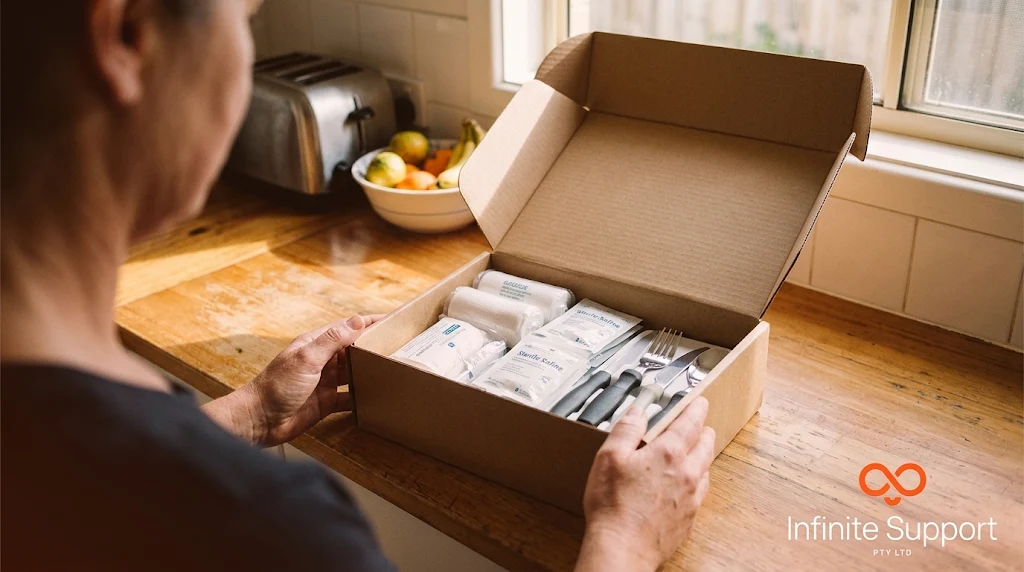
NDIS consumables are everyday items you need because of your disability, such as continence products, paid from the Consumables part of your Core budget. In our work with participants across Melbourne and Victoria, knowing what are NDIS consumables stops you paying out of pocket for supplies you use every week.
Key Takeaways
Consumables sit in Support Category 03 inside your Core Supports budget and usually share flexible funding with other Core categories.
Simple safety and daily living aids under $1,500 per item come out of your Consumables budget without quotes.
Self-managed and plan-managed participants can buy from any store, while NDIA-managed plans must use a registered NDIS provider.
Starting 1 December 2026, you must lodge claims within 90 days of receiving your supports instead of two years.
What Counts as an NDIS Consumable?
When participants ask us what are NDIS consumables, we explain that they are low-cost, single-use, or regularly replaced items linked directly to your disability. Under the NDIS pricing arrangements, these supplies sit in Support Category 03 inside your Core Supports budget.
Checking how NDIS funding works makes monthly budgeting easier. As set out in the guide to NDIS support budgets, Core funding is normally flexible across categories, so you can move unused money from daily personal care into consumables if supply costs go up. If your plan lists consumables as stated supports, you can only spend that exact amount on the named item, and you cannot shift Core money into Capacity Building or Capital budgets.
Every purchase must also meet the NDIA's reasonable and necessary rules, meaning the item relates directly to your disability and gives good value for money. The NDIS Core Supports guide groups everyday consumables into three areas:
Continence-Related Equipment
Continence supplies are the items participants order most often each month. This group covers disposable pads, absorbent pull-up pants, reusable continence underwear, waterproof mattress protectors, disposable urinary catheters, and drainage bags. For children aged five and older, the NDIA funds continence aids when ongoing incontinence comes from a disability, whereas children under five only qualify if they need catheters or far higher support than peers of the same age.
Eating, Drinking, and Home Enteral Nutrition
Participants with swallowing difficulties or tube-feeding needs can claim disability-related eating and nutrition items. Covered supplies include weighted or angled cutlery, non-slip plates, adapted cups, and Home Enteral Nutrition (HEN) gear such as feeding pumps, syringes, and giving sets. Where an Accredited Practising Dietitian or speech pathologist recommends them for disability management, you can also claim swallowing thickeners and prescribed enteral formula not covered by the Pharmaceutical Benefits Scheme.
Disability-Related Health Supplies
Managing ongoing health conditions often requires daily medical items tied to your impairment. Eligible disability-related health supports include wound dressings, sterile gauze, skin barrier creams, disposable gloves, podiatry orthotics, and breathing supplies such as CPAP tubing or nebuliser masks. Hearing aid batteries also sit inside this group.
Everyday Items You Cannot Claim
Under NDIA rules, you cannot spend plan money on standard household expenses that everyone pays, including supermarket groceries, regular soap, standard toilet paper, cosmetics, or non-modified kitchen appliances. Prescription medicines, over-the-counter painkillers, and acute hospital care sit under Medicare or the Pharmaceutical Benefits Scheme rather than the NDIS.
Standard consumer electronics such as iPads, smartphones, and smartwatches are also excluded from general consumables. If you need a standard tablet for communication software, you must apply to the NDIA in writing to buy it under the NDIS replacement supports pathway before spending any plan funds.
Low-Cost Assistive Technology Under $1,500
Once you know which single-use supplies qualify, the next step is checking how small reusable equipment fits into the same budget. Any assistive item costing under $1,500 per item is classed as low-cost assistive technology and comes straight out of your Consumables funds. In the NDIS pricing system, these items have no fixed price caps and are billed at a notional unit price of $1.00 per unit to match the exact dollar cost.
Low-Risk Items You Can Buy Straight Away
Simple, safe products that you can set up without specialist training are classed as low-risk. You do not need quotes, reports, or prior NDIA confirmation to buy low-risk aids under $1,500 when you have flexible Core funds available. Common examples we see families in Williams Landing and across Melbourne buy include:
Shower chairs, bath boards, and non-slip rubber bathmats
Long-handled reachers, sock aids, and easy-grip jar openers
Talking alarm clocks, visual schedule boards, and laminated communication cards
Basic suction grab rails for bathroom walls
Higher-Risk Items That Need Allied Health Advice
Price alone does not decide whether an item is safe to buy off the shelf. As set out in the NDIA guide on how to buy low-cost assistive technology, you must get written advice or an allied health assessment from an occupational therapist or physiotherapist if poor fitting could cause injury, even when the item costs less than $1,500. Higher-risk items include custom-moulded orthotics, pressure-relieving seat cushions, and slide boards for bed transfers, while any equipment costing $1,500 or more moves into Capital Supports and needs formal quotes.
How to Order Consumables With Your Plan Type
After confirming that an item meets the rules for what are NDIS consumables and whether it needs therapist advice, your plan management type decides where you shop and how invoices get paid. Checking your plan type before placing an order avoids rejected receipts and delayed deliveries.
Self-Managed Plans
Self-managed participants can buy from any registered or unregistered retailer, including local chemists, supermarkets, or online medical stores. As explained on the NDIS paying your supports page, you pay upfront, lodge your tax invoice via the my NDIS app or myplace portal for reimbursement within roughly two business days, and keep receipts for five years in case of an NDIA audit.
Plan-Managed Plans
Plan-managed participants can also order from both registered and unregistered suppliers across Australia. Instead of paying out of pocket, you ask the supplier to email an itemised tax invoice showing their ABN, the purchase date, and a clear item description directly to your plan manager for payment.
NDIA-Managed Plans
Agency-managed participants must buy all consumables and low-cost assistive technology strictly from a registered NDIS provider. Your chosen provider claims payment directly through the NDIA portal once your order ships.
New 90-Day Claiming Timeframe From 1 December 2026
Under the new 90-day claiming timeframe starting 1 December 2026, all NDIS claims must be lodged within 90 days of support delivery. Because this replaces the old two-year limit, we advise participants and suppliers to submit receipts and tax invoices right after each box arrives so you never miss out on reimbursement.
How a Support Coordinator Helps With Consumables
Managing repeat deliveries every month can feel tiring alongside daily health appointments and personal routines. Many participants we support across Melbourne's western suburbs run low on continence stock or spend their flexible Core pool too quickly early in their plan period.
A coordinator helps you map out monthly supply costs so consumables spending never leaves you short for daily living support workers or community access. Our team can also connect you with your choice of suppliers who issue compliant NDIS tax invoices, help you connect with an occupational therapist for written advice on higher-risk equipment, and set up automated repeat deliveries.
If ordering feels hard to manage, our NDIS support coordination team can set up regular orders with your suppliers.
Frequently Asked Questions
Can I use other Core Supports funding if my Consumables budget runs out?
Yes, you can usually use funds from other Core categories such as Assistance with Daily Life to cover consumables. Core Supports is flexible across categories unless your NDIS plan explicitly marks your Consumables line item as stated.
Does the NDIS fund nappies and continence aids for children?
The NDIS generally funds continence products for children aged five years and older who have ongoing incontinence caused by a disability. For children under five, nappies are treated as everyday family costs unless a medical disability requires disposable catheters or substantially higher support than peers of the same age.
Do I need a quote or occupational therapist report for low-cost assistive technology?
You do not need quotes or an assessment for low-risk assistive technology under $1,500, such as shower chairs, reachers, or non-slip mats. You only need written advice from an allied health professional if the item carries a safety risk, such as pressure cushions or transfer aids.
Can I buy an iPad or smartwatch with my NDIS Consumables budget?
No, standard tablets, smartphones, and smartwatches cannot be bought directly from your Consumables budget. You must submit a written request and receive written NDIA confirmation under the replacement supports rules before purchasing standard consumer technology.
Need Help Organising Your NDIS Supplies?
Our Melbourne team helps NDIS participants manage Core budgets, find reliable suppliers, and stay on top of changing NDIA rules. Contact Infinite Support to talk through your plan today.