

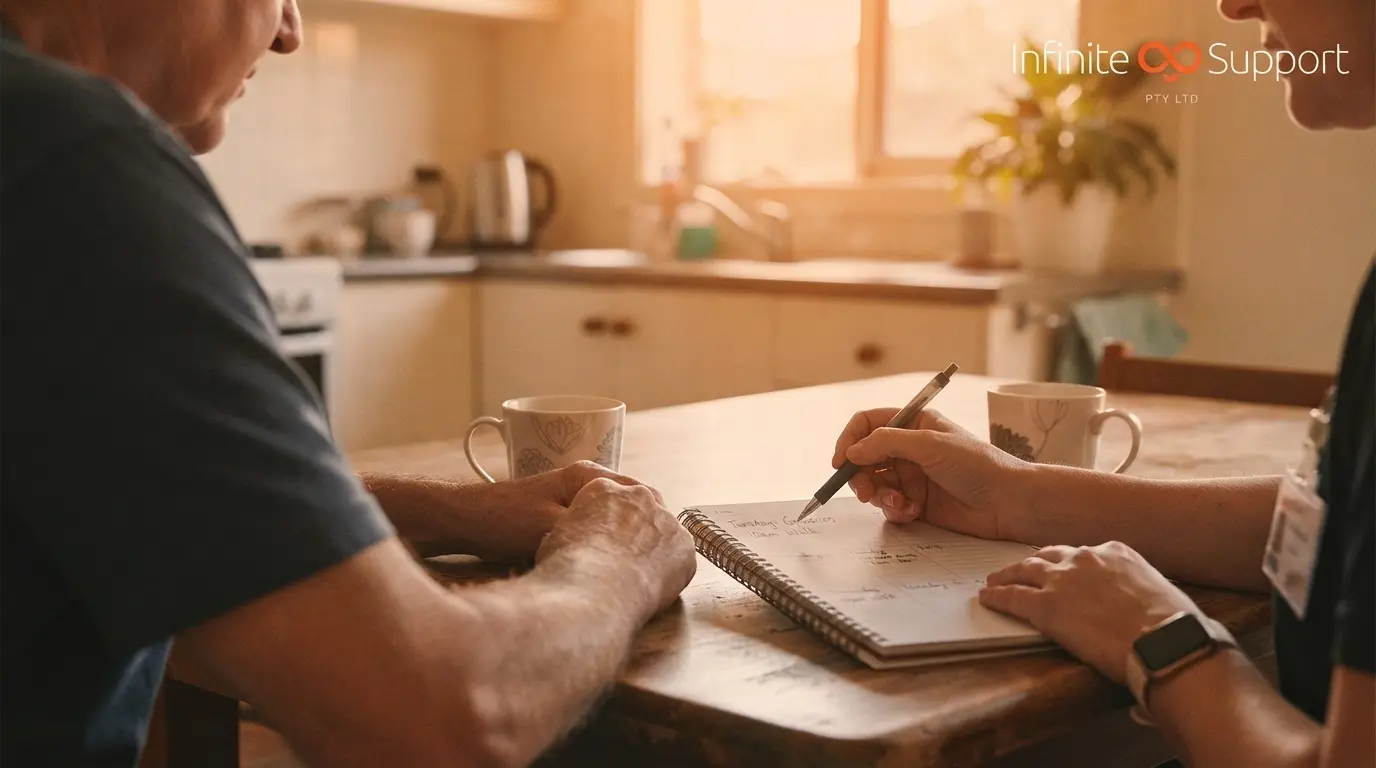
An NDIS psychosocial disability plan funds non-clinical supports that help you manage everyday life, build independence, and take part in your local community. The scheme does not pay for clinical medical treatments like hospital care or psychiatric prescriptions, but it can help with daily routines and capacity building.
Key Takeaways
Funding targets practical functional needs rather than a clinical medical diagnosis alone.
Core supports assist with everyday tasks like meal preparation, personal care, and domestic routines.
Capacity building funds recovery coaching, life skills development, and community participation.
Clinical therapies, crisis units, and medical treatments are the responsibility of the public health system.
Mobile support workers travel to your home across Melbourne's west to support your daily recovery goals.
What Counts as a Psychosocial Disability Under the NDIS?
A psychosocial disability describes the functional barriers a person experiences when a mental health condition impacts daily life. While many Australians live with mental health conditions, not all have a psychosocial disability. The difference lies in how severely the condition affects your daily independence and ability to take part in work, social life, and community activities.
The National Disability Insurance Agency (NDIA) evaluates how an impairment reduces daily capability under the statutory guidelines of the National Disability Insurance Scheme Act 2013. You can read the general rules in our NDIS eligibility guide. The NDIA requires evidence that your impairment is permanent or likely to be permanent before deciding on funding.
The qualification pathway follows a progression from health condition to practical funding:
First, an underlying mental health condition creates persistent barriers in daily routines.
Next, these barriers lead to substantially reduced functional capacity in everyday living.
Assessors then measure this impact across the six statutory life domains.
Finally, meeting these criteria confirms eligibility for funded disability supports under the scheme.
The Six Functional Capacity Domains
The NDIA measures your support needs across six core life domains:
Self-care: Showering, dressing, grooming, eating meals, and attending to physical hygiene.
Self-management: Organizing daily tasks, bill payments, medication reminders, and domestic decisions.
Social interaction: Making and keeping friendships, communicating feelings, and handling social settings.
Learning: Gaining new skills, understanding instructions, and building practical habits.
Communication: Expressing your needs and making choices when experiencing emotional distress.
Mobility: Leaving your house safely and using public buses or trains around your local area.
Having a substantially reduced functional capacity in at least one of these areas is what opens the pathway to NDIS funding.
How the NDIS Views Episodic Mental Health Conditions
Mental health conditions rarely stay the same from one week to the next. They are episodic mental health conditions by nature, meaning you will have good weeks alongside difficult periods. The NDIA recognizes that your functional capacity fluctuates over time.
When treating health professionals write reports for your access request, they must explain what your life looks like on difficult days. A period of wellness does not mean your disability has disappeared. The underlying impairment persists, and your evidence should describe the frequency, duration, and severity of your low-capacity episodes. This approach aims to ensure your plan includes flexible funding to maintain your routines when you need assistance most.
What Psychosocial Supports Does the NDIS Fund?
The scheme provides reasonable and necessary supports to help you achieve your personal recovery goals. We find that participants get the most value when they know how their funding splits between daily help and long-term skill building.
Core Supports for Daily Living and Household Routines
Your core supports budget provides practical help with everyday tasks. When mental health challenges drain your energy, simple chores can quickly pile up. Our team provides psychosocial and mental health support directly in your home, assisting with domestic routines like laundry, dishwashing, changing bed sheets, and preparing nutritious meals.
These supports divide into two main everyday settings:
Home Environment: Cleaning, laundry, nutritious meal preparation, and establishing morning self-care routines.
Community Access: Travelling safely to local shops, attending appointments, and joining community groups.
These supports also cover social and community participation. A support worker can walk alongside you to local shopping centres, support you at appointments, or accompany you on walks through local parks. Our mobile support workers meet you wherever you feel most comfortable, helping you build healthy daily rhythms.
Capacity Building for Independence and Life Skills
Capacity building supports focus on helping you learn, rebuild, and maintain skills for independent living. Instead of simply doing a task for you, a support worker works alongside you to build healthy routines. This might include practicing public transport routes, learning how to prepare budget-friendly recipes, or practicing budgeting at your local bank branch.
Support workers can also help you develop emotional self-management domain techniques outlined by your allied health practitioners. They do not diagnose conditions or offer clinical therapy, but they reinforce your daily habits so you can remain confident in your community.
Psychosocial Recovery Coach vs Support Coordinator
Many participants ask whether they should request a recovery coach or a support coordinator. Both professionals assist you, but their day-to-day focus is different. You can read how a recovery coach differs from a support coordinator to see how each role works in practice.
The Role of a Support Coordinator
Focuses on NDIS plan administration and navigating service systems.
Connects you with suitable service providers in your local area.
Manages service agreements and tracks funding balances.
Prepares formal implementation reports for your scheduled plan reviews.
Helps resolve service delivery roadblocks between external providers.
The Role of a Psychosocial Recovery Coach
Focuses on personal recovery goals and building your inner resilience.
Designs collaborative recovery plans that adapt to fluctuating mental health needs.
Helps you identify early warning signs and manage changing capacity levels.
Works closely with your clinical mental health team and informal carers.
Often brings lived experience of mental health challenges to the working relationship.
A psychosocial recovery coach focuses directly on your personal recovery journey and building your resilience. They collaborate with you, your family, and your clinical team to design a recovery plan that responds to your fluctuating needs. Many recovery coaches bring their own lived experience of mental health challenges, providing practical insights and genuine empathy.
A support coordinator focuses on the mechanics of the scheme. They help you understand your budget, negotiate service agreements, find suitable providers, and address service barriers. Many participants with complex recovery needs receive funding for both roles in their plan.
What Does the NDIS Not Fund for Mental Health?
The NDIS operates under strict legislative guidelines, which you can explore on the NDIS Mental Health and the NDIS portal. The scheme does not replace mainstream public health services, and it will not fund:
Clinical treatments: Visits to general practitioners, clinical psychiatrists, psychologist therapy sessions, and prescription medications.
Acute medical care: Inpatient hospital admissions, medical detoxification beds, and crisis triage interventions.
Everyday living costs: Standard house rent, utility bills, weekly groceries, and entertainment tickets.
Alternative therapies: Treatments lacking strong clinical evidence, such as unregulated alternative remedies.
The public mental health system handles acute medical needs, diagnosis, and medical care. The NDIS steps in to provide non-clinical recovery support that enables you to lead a fulfilling life in your community.
Proving Functional Impairment for Your Application
Securing funding for an ndis psychosocial disability requires thorough medical and functional evidence. The NDIA does not base decisions on your diagnosis alone. You must clearly demonstrate how your mental health condition impacts your day-to-day life.
The Application Steps
Gather Medical Records: Collect diagnostic history, treatment chronologies, and letters from treating health professionals.
Complete the Official Forms: Have your primary treating doctor or psychiatrist document functional capacity across the six life domains on the official Evidence of Psychosocial Disability Form.
Document Fluctuating Needs: Prepare personal statements detailing episodic downturns and bad-day support requirements.
Submit for Review: Submit your complete application pack to the NDIA for an access determination under statutory guidelines.
Core Evidence to Prepare
Evidence from treating professionals: Gather reports from your general practitioner, psychiatrist, clinical psychologist, or mental health social worker. They must confirm that your condition is permanent and that available treatments have been explored.
Standardized assessments: Independent functional capacity assessments carried out by occupational therapists help quantify how your condition limits your independence.
Evidence of Psychosocial Disability form: Have your primary clinician complete this official NDIA form, giving clear examples across the self-management, self-care, and social interaction domains.
Carer and personal statements: Write an honest description of what happens during your lowest days. Highlight the tasks you cannot complete without hands-on help or prompting.
All registered providers must follow price limits set under the NDIS Pricing Arrangements and Price Limits. These caps ensure your budget is billed correctly for every hour of support. For more details on current rates, review our breakdown of the NDIS price guide 2026 and new hourly limits.
Psychosocial Support Across Melbourne's Western Suburbs
Living with a mental health condition can feel isolating, especially when dealing with language barriers or cultural stigma. Infinite Support operates as a mobile, registered NDIS provider based at Unit 517/87 Overton Rd, Williams Landing VIC 3027. Our support workers travel directly to your home, school, or local community hub across Williams Landing, Point Cook, Tarneit, Wyndham Vale, Hoppers Crossing, Seabrook, Laverton, and Altona Meadows.
Our mobile network connects participants directly from our Williams Landing hub:
Point Cook and Seabrook: Regular home visits to help establish daily personal care and household routines.
Tarneit and Truganina: Community access support that builds confidence in public transport and recreation hubs.
Hoppers Crossing and Werribee: Practical skill building sessions to strengthen social connection and independence.
We understand the diverse communities across the City of Wyndham. Our multicultural and multilingual team speaks English, Arabic, Turkish, and Tamil, helping participants and families communicate comfortably without cultural friction. We respect participant choice and control, ensuring you decide who provides your support and how your routines run.
To support consistent delivery of your care, we offer a 3+ rotating staff model. This model ensures that at least three trained staff members are introduced to your team, aiming to keep your support routines seamless even when team members take leave. We also focus heavily on staff wellbeing and support so that we can continue to show up with the compassion, care, and consistency your routine requires.
Participants across Victoria can explore additional advocacy rights and service standards through the Victorian Mental Health and Wellbeing Commission, which protects the rights of people receiving mental health services across the state.
Frequently Asked Questions
What mental health conditions qualify for NDIS psychosocial disability funding?
The NDIS does not maintain a strict list of approved conditions. Diagnoses such as schizophrenia, bipolar disorder, severe major depression, post-traumatic stress disorder (PTSD), and obsessive-compulsive disorder (OCD) can qualify if they result in permanent, substantial functional impairment that impacts everyday living.
Can I get an NDIS support worker for mental health appointments?
An NDIS support worker can assist you with travel and accompany you to your medical or therapy appointments. However, the support worker cannot attend the clinical session as a treatment provider or replace your medical specialist. Their role is to assist with transport, scheduling, and emotional encouragement.
What happens to my NDIS funding when I feel better?
Your NDIS plan remains active throughout its approved duration. Because mental health conditions fluctuate, periods of improvement are expected during recovery. Your funding remains available so you can maintain capacity building routines and quickly step up daily living assistance if an episodic downturn occurs.
How do I switch my mental health support provider in Melbourne?
You have full choice and control over your providers. Review your current service agreement for any notice period requirements, notify your provider in writing, and reach out to a new registered NDIS provider to arrange support worker matching and service planning.
Speak With Our Melbourne Team
Our mobile team provides reliable daily living assistance and recovery support tailored to your unique goals.