

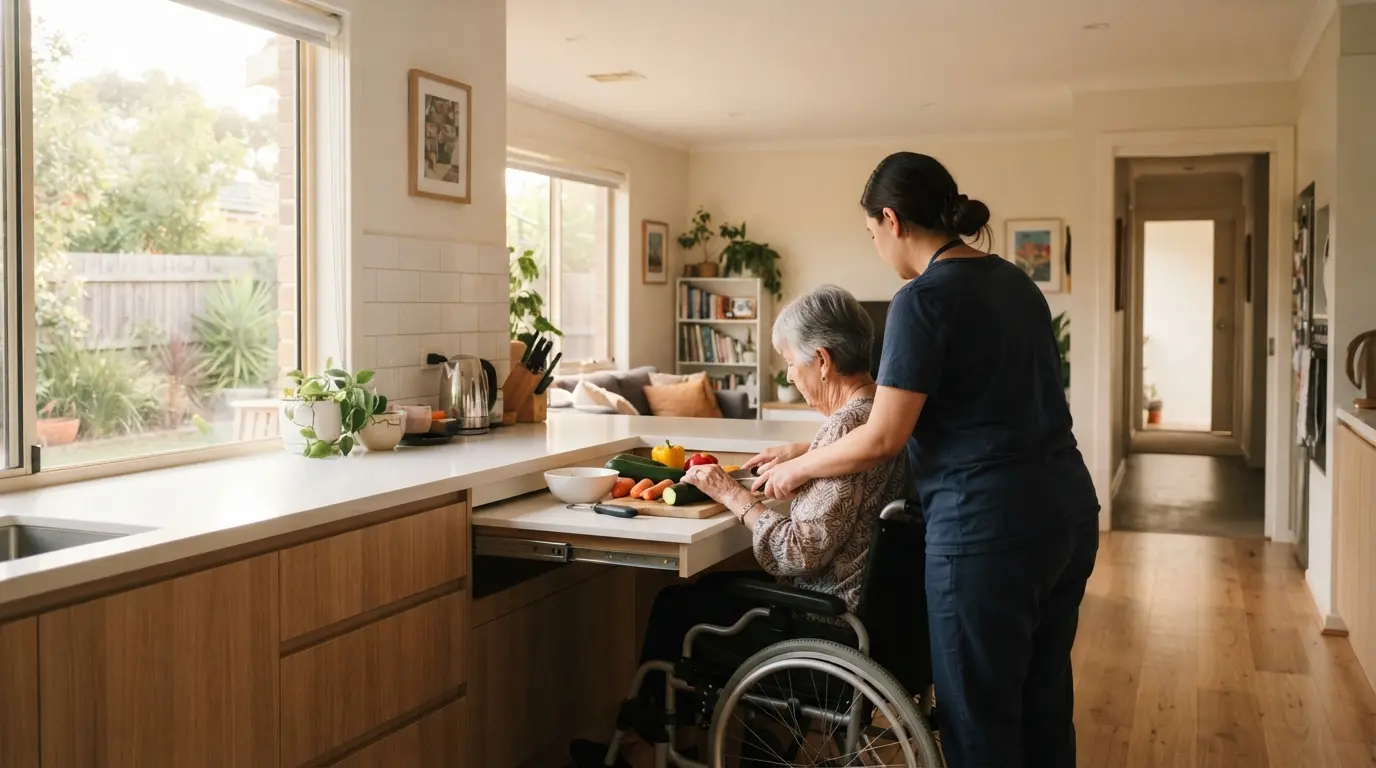
SDA vs SIL comes down to one simple split: SDA funds the home, and SIL funds the people who support you in it. The NDIA notes that some people have both in their plans, and others need only one. We're Infinite Support, an NDIS registered provider in Williams Landing, and this guide explains each option, who pays rent, and where short and medium term stays fit.
Key Takeaways
In SDA vs SIL, SDA is funding for specially designed housing and SIL is funding for support workers, up to 24 hours a day.
Neither pays your rent. In Victoria, SDA rent is capped at a share of your pension plus Commonwealth Rent Assistance.
Short term accommodation is usually funded for up to 28 days a year. Medium term accommodation covers up to 90 days while a long-term home is not ready.
From 1 July 2026, SIL providers must be registered with the NDIS Commission, which matters in any SDA vs SIL choice.
SDA vs SIL: What Is the Difference?
The difference in SDA vs SIL is that SDA pays for a building and SIL pays for support. The NDIA describes SIL as funding for a support worker to help you 24 hours a day, 7 days a week. SDA, by contrast, doesn't include NDIS supports or other services you get at home.
People asking about SDA vs SIL are often asking two things at once: where will I live, and who will help me there? Keeping those questions apart makes planning meetings easier, so we start with the home itself.
What Does SDA Funding Cover?
SDA funding covers housing built for people with extreme functional impairment or very high support needs, in a house, apartment, villa, duplex or townhouse. The NDIA groups SDA homes into four design categories:
Improved Liveability: better access and features for people with sensory, intellectual or cognitive impairment.
Fully Accessible: a high level of physical access, such as for wheelchair users.
Robust: strong, durable construction that keeps residents and others safe.
High Physical Support: features such as ceiling hoists, backup power or home automation.
SDA providers must be registered with the NDIS Commission, and the NDIA decides whether to enrol a home after it is built. SDA is also uncommon in SDA vs SIL planning: the NDIA SDA Report 2026 found 25,502 participants had an SDA need at 31 December 2025, just 3% of all participants.
Victoria has the highest SDA utilisation of any state or territory at 73%, with the same SDA report counting 7,340 Victorians with an SDA need and 3,805 enrolled dwellings. A building is only half the picture, though, which is where SIL comes in.
What Does SIL Funding Cover?
SIL funding covers support workers who help or supervise day-to-day tasks in your home. The NDIA says SIL can suit people who need more than 8 hours of active support a day, plus supervision for the rest. You can share a support worker or have your own, depending on how much help you need.
A roster of care can map weekly support, but the NDIA says a roster of care isn't a requirement and doesn't need to be submitted. For more detail, read what SIL is and how it's funded.
The rules on the SIL side of SDA vs SIL also changed in 2026. The NDIS Commission confirmed mandatory registration for SIL providers from 1 July 2026, and Plan Partners reports that providers not registered by 1 October 2026 cannot keep delivering NDIS SIL. Under the new SIL Practice Standards, your provider must give you a tenancy and home support agreement.
Can You Have SIL vs SDA Together or Separately?
SIL vs SDA is not an either-or choice, and the NDIA notes that some people have both in their plans. Others get SIL without SDA, since you can get SIL living alone or with other NDIS participants.
Some people do not need support around the clock. The NDIA says individualised living options, or ILO, let you choose where you live, who you live with and how you are supported, for people who need at least six hours of support a day.
If SIL is in your plan, you may also have funding for a support coordinator, which can help when you weigh up SDA vs SIL against ILO. Whichever mix you choose, the next question is usually money.
Who Pays Rent in SDA and SIL Homes?
Neither side of SDA vs SIL pays your rent, because the NDIS treats rent as a day-to-day living cost. SIL can't be used for rent or groceries, and SDA residents pay a reasonable rent contribution plus bills like electricity. Rent is covered in what the NDIS pays towards housing costs.
In Victoria, Consumer Affairs Victoria caps SDA rent at 25% of the basic Disability Support Pension, plus 25% of any pension supplement and youth disability supplement, plus all of your Commonwealth Rent Assistance. Under the same rules, your provider cannot ask for more than 30 days' rent in advance.
Victorian SDA homes also come with tenancy rights, because Consumer Affairs Victoria notes that SDA residency agreements became part of the Residential Tenancies Act 1997 in July 2019. Not everyone is ready for a long-term SDA vs SIL move, so the NDIS also funds shorter stays.
When Does NDIS Short Term Accommodation Help?
Short term accommodation through the NDIS gives you time away from your usual care arrangements, and the NDIA says it is usually funded for up to 28 days a year, in blocks of up to 14 days. STA covers support and standard accommodation such as a cabin, hostel or respite accommodation, but not food or meals.
Short term accommodation NDIS funding is aimed at people who live with family, friends or a carer or get daily drop-in support. A short stay can be a low-pressure way to try living away from home before you settle SDA vs SIL for the long term.
When Does NDIS Medium Term Accommodation Help?
Medium term accommodation NDIS funding pays for somewhere to live for up to 3 months, or 90 days, when you cannot yet move into your long-term home. MTA covers accommodation only, not food, internet or electricity, and personal care is funded separately.
MTA can also help with leaving hospital. The NDIA can add MTA to your plan at discharge if you are eligible for SDA, SIL, ILO or home modifications. Once the SDA vs SIL side of your long-term home is settled, the choice of SIL provider matters most.
What Should You Ask a SIL Provider in Melbourne's West?
The right questions to ask a SIL provider cover registration, staffing and your written agreement. Infinite Support has been NDIS registered since 2019, and we work with a minimum of three dependable staff per person so support stays consistent. See our SIL and accommodation support in Melbourne's west.
Are you registered with the NDIS Commission to deliver SIL?
Will I get a tenancy and home support agreement that shows all costs?
How do you match housemates and sort out conflict?
If I live in SDA, is my SDA provider separate from my SIL provider?
We support participants across Williams Landing, Point Cook, Tarneit, Hoppers Crossing and Werribee, and we also offer support coordination. We cannot promise funding or a place in a home, but we can talk through SDA vs SIL with you.
Frequently Asked Questions
Can I get SIL if I live in my family home?
SIL is delivered in your home, but the NDIA says other home and living options may suit you better if you live with people who are not NDIS participants, such as family. The same page points to other options if you want to self-direct your supports. A support coordinator can help you compare them with your planner.
Does the NDIS pay for food in SIL or SDA homes?
No. On either side of SDA vs SIL, the NDIA says SIL doesn't include day-to-day living costs that aren't linked to disability support, and SDA residents pay day-to-day costs such as electricity too. Your tenancy and home support agreement should explain what your support costs.
How do I check if a SIL provider is registered?
You can search the NDIS Commission's provider register using the provider's ABN, as Plan Partners explains. Check that the listing is current before you sign a tenancy and home support agreement. For more information, the NDIS Commission's SIL guide lists its phone line, 1800 035 544.
Talk to Us About SIL in Melbourne's West
Call 0414 922 768 or send us a message to talk through your housing and support options.
Button: Contact Infinite Support